IMPROBABLE RESEARCH GROUP
Where creation becomes science & science becomes creation
Bloomsbury book seriespassionately transforming management
The Improbable Research Group is proud to support Prof. Damien O’Doherty (University of Liverpool) and Prof. Daniel Hjorth (Lund University School of Economics and Management / Copenhagen Business School) in the search for contributors to their new book series.
Do you have something meaningful to share — perhaps something beyond simply wanting to publish?
We invite potential authors and collaborators to directly contact the editors by clicking on their names.
Our Method and Practice
Since 2011, Professor Sylvain Bureau (ESCP) and Pierre Tectin (artist) have been developing — through ongoing collaborations — a formal approach known as Art Thinking.
This agile method draws from artistic practices to explore the unknown and embrace uncertainty as a source of creation: a way to make what does not yet exist. It combines scientific rigor with artistic impertinence to bring forth the improbable.
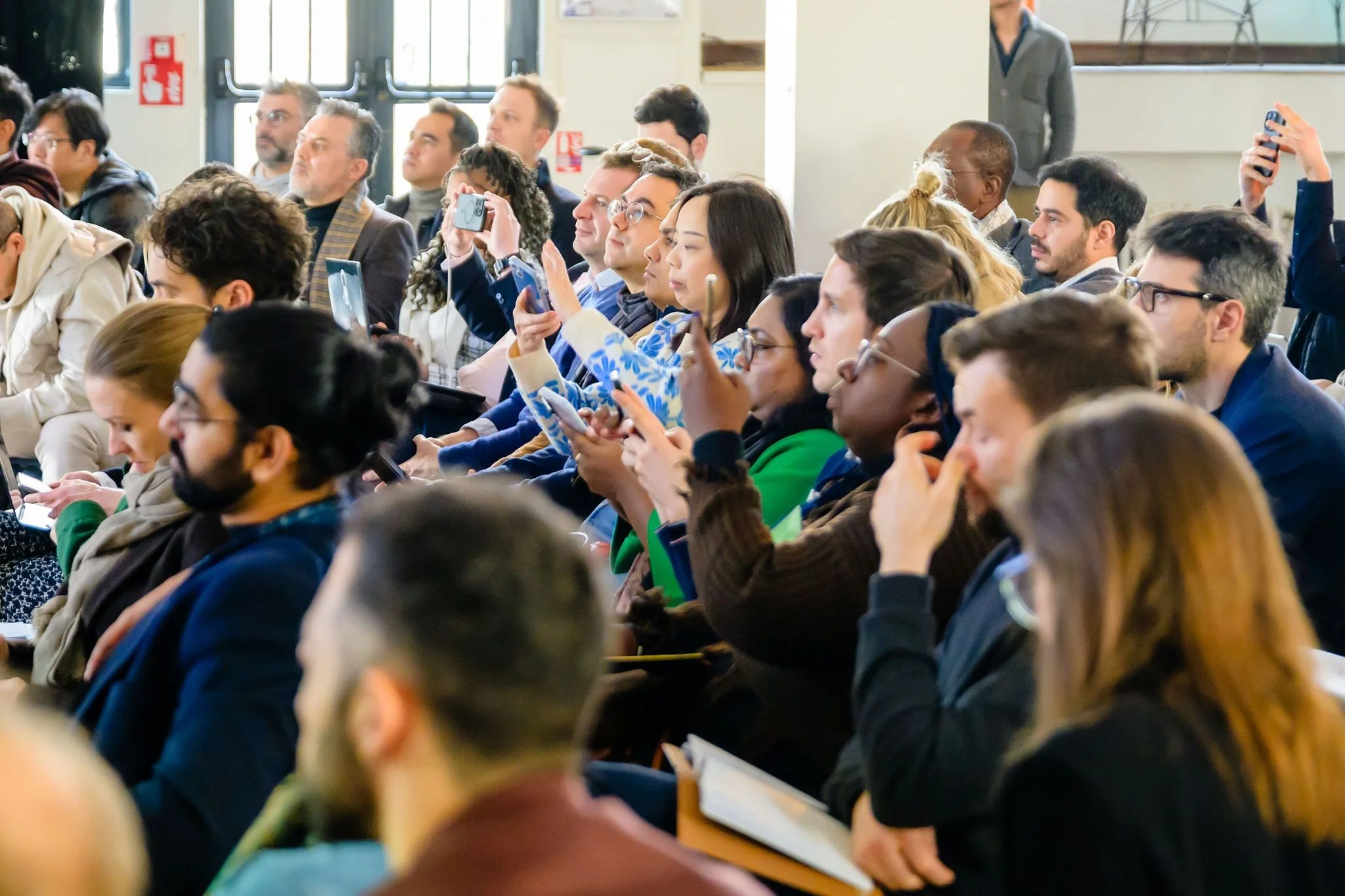
At the Improbable Research Group, creation itself becomes a method of inquiry. Our work fosters a reciprocal movement in which scientists create and artists think scientifically. Through seminars and collective experiments, we practice creation as a living, experimental method, both a way of investigating and a force for transformation.
Our Mission
We study how creation transforms the world, and how individuals and organizations can generate the unexpected, challenge norms, and cultivate new forms of intelligence: social, emotional, political, and aesthetic.
Our work designs new modes of intervention — workshops, collective inquiries, and public exhibitions — that connect knowledge and experience through living, participatory pedagogy.
RESEARCH AXES
-
We develop and formalize creative experimentation as a legitimate method of inquiry for organizations and entrepreneurs.
This line of research examines how artistic exploration and scientific investigation can combine to turn the improbable into replicable and adaptable practices, producing actionable knowledge for innovation in complex environments.Example: Research-Creation— exploring how art-based approaches can open new scientific frontiers involving the body, perception, and aesthetic sensibility.
Illustrative Reference
Biglieri, S., & Mandalaki, E. (2025). “Autre chose”: Rethinking (post)qualitative methodologies through research-creation in/for the study of organizations.Qualitative Research in Organizations and Management: An International Journal, 1-21.ption text goes here -
We design and study experiential and participatory learning models for students, executives, engineers, designers, and scientists.
This research explores how embodied and collective learning enables individuals to navigate uncertainty, generate ideas, and co-create — making creativity and experimentation both visible and shareable.Example: Improbable Seminar— studying how Art Thinking can be taught through art-based practices, new temporalities, and transformative learning spaces.
Illustrative References
Endrissat, N., & Islam, G. (2022). Hackathons as affective circuits: Technology, organizationality and affect.Organization Studies, 43(7), 1019-1047.
Bureau, S. P., & Komporozos-Athanasiou, A. (2017). Learning subversion in the business school: An “improbable” encounter.Management Learning, 48(1), 39-56.cription text goes here -
We analyze the major transformations of our time — from AI and digital disruption to climate change, sustainability, social inequality, and emerging forms of leadership.
This research track develops and tests collective and creative approaches to generate improbable solutions, producing insights relevant to organizations, entrepreneurs, and communities.Examples:
AI & AI — studying how Artificial and Artistic Intelligence diverge, complement, or confront one another.
llustrative Reference:
Bureau, S., & Ransler, C. (2024). AI vs AI: The Battle Between Artificial and Artistic Intelligence to Shape Human Creativity. Darden Business School Working Paper No. 5458134. SSRN linkEcological Challenges — examining how art-based practices help societies confront the Anthropocene and regain agency in turbulent times.
Illustrative Reference:
Bureau, S., Whitaker, A., & Gerges-Yammine, R. (2024). Regaining control in troubled times:Art Thinking as a method in a PUCA world.ESCP Impact Paper No. 2024-01-EN.ption text goes here
-
We explore creation as a critical and participatory practice, where thinking and doing are inseparable. This research line develops new theoretical perspectives, challenges established paradigms, and expands how we understand and enact creation and innovation generating conceptual frameworks relevant to organizational and entrepreneurial contexts.
Example: Subversive Creativity — examining how creative actors such as entrepreneurs not only disrupt markets but also subvert socio-political systems through critical forms of creativity.
Illustrative References
Tornikoski, E., & Shomali, A. (2025). Critical Creativity: A Conceptual Framework for Ethically Reflective and Transformative Practice. Working paper.
Bureau, S., Thor Sigurdarson, H., & Dey, P. (2025). Subversive and/or Disruptive? Unpacking the Political Force of Entrepreneurship. RENT Conference, Enschede, The Netherlands.
Bureau, S., & Zander, I. (2014). Entrepreneurship as an art of subversion.Scandinavian Journal of Management, 30(1), 124-133.
AN IMPROBABLE team
We gather a team of 40+ scientists, artists & cultural entrepreneurs :
Scholars
Pr. Thomas Blonski — ICN, France
Pr. Sylvain Bureau — ESCP, France
Pr. Fiametta Cascioli — Kedge, France
Pr. Céline du Boys — Aix-Marseille University, France
Pr. Chuck Eesley — Stanford University, USA
Pr. Nada Endrissat — Bern University of Applied Sciences, Switzerland
Pr. Laetitia Gabay-Mariani — ESCP, France
Pr. Rand Gerges-Yammine — ESCP, France
Igor Galligo — PhD student, Paris 8 Univ, France
Stéphane Lelong — Dauphine University, France
Maxime Massey — Affiliate Researcher, French Army
Pr. Robert Pearce — Exeter University, England
Pr. Chloé Preece — ESCP, UK
Pr. Charles Ransler — UVA, USA
Pr. Antonio Somaini — Sorbonne Nouvelle France
Maxime Massey — Affiliate Researcher, French Ar
Pr. Katrin Smolka — Warwick University, England
Pr. Erno Tornikoski — MBSC, Saudi Arabia
Pr. Amy Whitaker — NYU, USA
Artists
Nadja Belhadj — Artist, France
Christophe Bruno — Artist, France
Mathis Collins — Artist, France
Niko de la Faye — Artist, France
Hein Duijnstee — Artist, Netherlands
Nicolas Guiraud — Artist, France
Lena Karson — Artist, France
Emile Kirsch — Artist, France
Jorg Reckhenrich — Artist, Germany
Pierre Tectin — Artist, France
Sophia Trad — Artist, France
Alessandro Vassapoli — Artist, Italy
Cultural Entrepreneurs
Ahlam Benlemselmi — Public sector & art-based interventions, France
Rajesh Bhat — Consulting, India
Sara Biglieri, Ph.D — Dance & improvisation, France
Quentin Bitran - AI & cinema, France
Valérie Bobo — Art-based interventions, France
Wei-Yun Chang — Art exhibition, Taïwan
Hannaa Ingar — Art-based interventions & well-being, France
David Kao — Art exhibition, Taïwan & Canada
Eric Lévy — Art-based interventions, France
Nat Luna — Art-based interventions, Brazil
Anaïs Montervecchi — Art Critic & Mediator, France
Daniela Pavlova — ESCP, Spain
Nil Samar — Art Mediator, France
Olivier Simha — Thalès, Expert
Koen Snoeckx — Art-based interventions, Belgium
Catherine Tannitte — Art-based interventions, France
Florence Tadjeddine — Coach, France

MAIN PUBLICATIONS
Bureau, S., Whitaker, A., & Hjorth, D. (2027). Enterprising Tricksters & Entrepreneurial Pranksters? Play, Art, Power, Tactics, and Subversive Resistance against Tech Elites Threatening Democracy. EGOS, Liverpool.
Bureau, S., Gabay-Mariani, L., Buriller, J., & Cascioli Karivalis, F. (2026). Challenging business schools through subversive performativity: The potential of art-based pedagogies. British Journal of Management, e70078.
Bureau, S., & Ransler, C. (2025). AI vs AI: The Battle Between Artificial and Artistic Intelligence to Shape Human Creativity. ESCP Business School Impact Paper & Darden Business School Working Paper No. 5458134.
Buriller, J., & Bureau, S. (2024). Enseigner l’Anthropocène par les imaginaires : Le cas d’une pédagogie fondée sur la création artistique. Revue française de gestion, 315(2), 207–225.
Bureau, S., Whitaker, A., & Gerges-Yammine, R. (2024). Regaining Control in Troubled Times: Art Thinking as a Method in a PUCA World. ESCP Impact Paper, No. 2024-19-EN.
Bureau, S. (2022). Agile Methods: How Can We Stop Hyper-Focusing on Clients, and Why? White Paper, Jean-Say Institute, ESCP Business School.
Bureau, S. (2019). Art Thinking : Une méthode pour créer de l’improbable avec certitude. Entreprendre & Innover, 42–43(3), 88–103.
Whitaker, A. (2016). Art Thinking: How to Carve Out Creative Space in a World of Schedules, Budgets, and Bosses. HarperCollins.
Bureau, S. (2013). Une expérimentation improbable pour désapprendre. Revue Internationale de Psychologie et de Gestion des Comportements Organisationnels, 19(47), 201–225.
Bureau, S. (2026). Creating in Order to Give, Giving in Order to Create. Chapter 2 of Art Thinking: The Method for Creating the Improbable. Work in progress.
André, K., Bureau, S., Rubel, O., & Gautier, A. (2017). Beyond the opposition between altruism and self-interest: Reciprocal giving in reward-based crowdfunding. Journal of Business Ethics, 146(2), 313–332.
Bureau, S., & Fendt, J. (2011). Entrepreneurship in the informal economy: Why does it matter? International Journal of Entrepreneurship and Innovation, 12(2), 85–94.
Bureau, S. (2026). Deviate: When Creation Feeds on Creations. Chapter 3 of Art Thinking: The Method for Creating the Improbable. Work in progress.
Doussard, C., Billion, J., Renouf, J., & Bureau, S. (2023). Barefoot entrepreneurs trapped in liminal spaces: The case of homeless youths in New York City. Entrepreneurship & Regional Development, 35(9–10), 938–955.
Bureau, S. (2014). Piracy as an avant-gardist deviance: How do entrepreneurial pirates contribute to the wealth or misery of nations? International Journal of Entrepreneurship and Small Business, 22(4), 426–438.
Bureau, S., & Ibrahim, R. (2025). The dialectic of ‘creative-destruction’: A fabric of entrepreneurial heroes, the case of an emblematic novel: The Ladies’ Paradise. International Journal of Entrepreneurial Venturing, 17(2), 126–148.
Bureau, S., & Zander, I. (2014). Entrepreneurship as an art of subversion. Scandinavian Journal of Management, 30(1), 124–133.
Bureau, S. (2013). Entrepreneurship as a subversive activity: How can entrepreneurs destroy in the process of creative destruction? M@n@gement, 16(3), 204–235.
Doussard, C., Billion, J., Renouf, J., & Bureau, S. (2023). Barefoot entrepreneurs trapped in liminal spaces: The case of homeless youths in New York City. Entrepreneurship & Regional Development, 35(9–10), 938–955.
Bureau, S., & Koufaris, M. (2012). How to Teach Effectuation: The Situationist Dérive as a Solution?. Academy of Management, Boston, MA, August 3–7.
Bureau, S., & Fendt, J. (2012). La dérive « situationniste » : Le plus court chemin pour apprendre à entreprendre ? Revue française de gestion, (4), 181–200.
Bureau, S. (2026). Dialoguing: Spectacular Monologues or Prosaic Dialogues. Chapter 6 of Art Thinking: The Method for Creating the Improbable. Work in progress.
Massey, M., Bureau, S., & Naccache, P. (2023). Comment les organisations pirates construisent-elles leur légitimité ? Le cas de la start-up Heetch. Revue française de gestion, 312(5), 55–74.
Bureau, S., & Komporozos-Athanasiou, A. (2017). Teaching subversion in the business school: An ‘improbable’ encounter. Management Learning, 48(1), 39–56.
Bureau, S., Gerges-Yammine, R., Battaglia, D., & Zhou, J. (2025). Legitimising destructive entrepreneurship: The case of a crypto-entrepreneur. Small Business Economics, 1–14.
Gabay-Mariani, L., Buquet, R., & Bureau, S. (2021). Le piège du pitch ou l’ambivalente performance d’un discours spectaculaire. Entreprendre & Innover, 51(4), 43–56.
Waroquiers, C., & Bureau, S. (2018). Free Your Pitch: Make Presentations People Remember. Pearson.